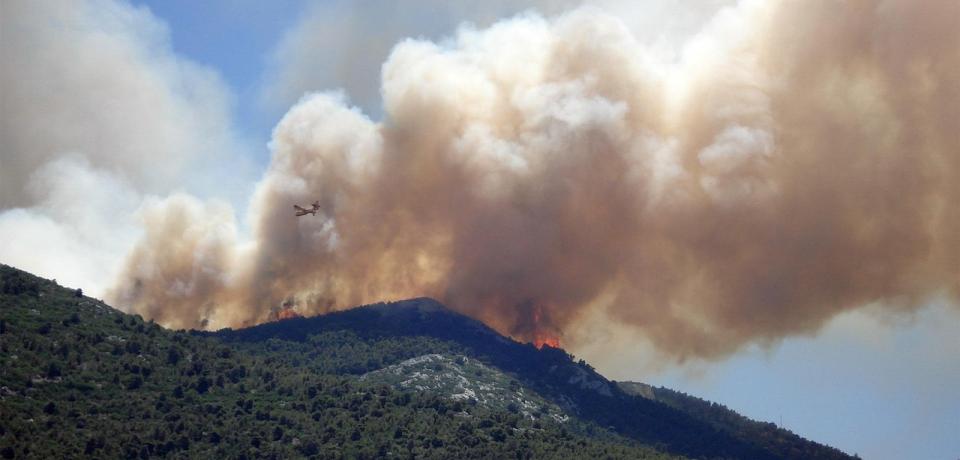
In less than two months, Europe has been hit by three heatwaves that are exceptional in terms of their early onset, intensity, duration and geographical extent.
The health impacts are numerous and dramatic: respiratory problems caused in particular by ozone formation (from nitrogen oxide emissions from internal combustion engines – ozone levels exceeded safe limits in June for 300 out of 450 million Europeans); cardiovascular events; infectious diseases; acute kidney failure; air pollution from forest fire smoke. These consequences further exacerbate social inequalities linked to housing, transport, working conditions and income. The number of excess deaths runs into the thousands. The poorest regions, where people have the least means of protecting themselves from the heat and pollution, are experiencing excess mortality rates of nearly 80 per cent, similar to those seen during the COVID-19 pandemic.
Humans are not the only ones suffering and dying. Farm animals are paying a heavy price, particularly cattle (which are physiologically ill-suited to such temperatures) and poultry. Tens of thousands have died in industrial ‘meat factories’. Apart from the ethical shock caused by this mass slaughter, it forms part of the wider context of the heatwave’s serious consequences for agricultural production and food sovereignty. This has a knock-on effect on consumer prices (already on the rise due to the Trump–Netanyahu war against Iran). Here too, it is the working classes who are hardest hit.
The impacts on terrestrial and aquatic ecosystems are no less dramatic. Extreme heat, severe droughts and wildfires are killing vast numbers of birds, insects, fish, amphibians and mammals… The damage to terrestrial ecosystems (notably forests, hedgerows and wetlands) is the most visible, but the accelerating transformation of marine environments is equally worrying. Generally speaking, this deals a further severe blow to biodiversity that is already severely weakened by agribusiness, industrial fishing and the tourism industry. In a sort of boomerang effect, these sectors are now experiencing a backlash that will not be without global economic consequences.
These heatwaves form part of a pattern of extreme weather events that are becoming increasingly frequent across the globe. To mention only the most recent examples: in India, temperatures reached 45°C in May; in China, particularly violent typhoons are causing severe flooding in Guangxi, whilst a heatwave is affecting Xinyang; the Antarctic Peninsula, in the midst of the Antarctic winter, has seen temperatures of +5°C, 20°C above seasonal averages…
Experts are categorical: most of these events could not have occurred without global warming. We know that this is mainly due to the accumulation in the atmosphere of vast quantities of CO₂ emitted through the burning of fossil fuels. The mechanism is well understood: due to the rising concentration of CO₂ and other greenhouse gases, the Earth system is experiencing a growing energy imbalance , which is triggering increasingly violent ‘adjustments’. Yet this is only the beginning. The oceans absorb the bulk of the excess energy (90 per cent). The fact that they are currently experiencing the hottest first half of the year on record is a sure sign of even more severe disasters to come. In the short term, the effects will be amplified by the arrival of El Niño (a natural phenomenon whose record intensity is probably not unrelated to the warming of the ocean waters).
The conclusion is clear: global warming is, right now, plunging the Earth into a catastrophe that is irreversible on a human timescale. A catastrophe that hits the poor in poor countries and the working classes in so-called ‘rich’ countries particularly hard. This is the first message of the heatwave.
This situation was foreseeable and had been warned about, notably in successive IPCC reports. The solution is also well known: we must, as a matter of urgency, begin immediately to drastically reduce greenhouse gas emissions and phase out the use of fossil fuels as quickly as possible. But following the grand proclamations of the 2015 Paris Agreement (“to keep the temperature rise well below 2°C whilst pursuing efforts to limit it to 1.5°C”), business as usual has continued. It is worth noting that the agreement did not even mention fossil fuels. Ninety-five per cent of its promises to stabilise the climate were based on scenarios involving the massive roll-out of carbon capture and storage, emissions offsetting, geoengineering, ‘clean coal’ and ‘decarbonised nuclear power’. The peddlers of false technological solutions had only one thing in mind: to make people believe that the climate could be stabilised without leaving fossil fuels in the ground. We can see the result…
An energy-efficient system, based 100 per cent on renewables, can meet real human needs—determined democratically and in a spirit of solidarity—whilst respecting ecological limits. But implementing it requires a reduction in final energy consumption, by eliminating unnecessary production and transport. Yet this is precisely what Capital refuses to accept at any cost. Democracy, solidarity, the satisfaction of real needs and respect for ecological limits are more incompatible than ever with its market-driven logic of competition for profit. Productivist by nature and historically rooted in fossil fuels, the system must produce ever more by investing in machinery, and exploit labour and the Earth ever more intensely in order to combat the tendency for the rate of profit to fall. There can therefore be no question of an ‘energy transition’. More than thirty years after the Earth Summit (Rio 1992), the share of fossil fuels in the global energy mix still hovers around 80 per cent, and annual emissions continue to rise. The absurd logic of an out-of-control automaton is dragging humanity towards the abyss.
This is the second message of the heatwave: since the Industrial Revolution, Capital has been fossil-based; it remains so and intends to continue being so, whatever the human and ecological cost.
In recent years, we have witnessed a widespread rollback of environmental policies in general, and climate policies in particular (the ‘green backlash’). COP 28 (2022) had half-heartedly adopted the objective of a ‘transition away from fossil fuels’. Blah, blah, blah. Investment in oil, coal and natural gas continues as if nothing had happened. The 65 largest banks even increased their investment in 2024 and 2025.
The backlash is fierce in the United States, of course, and not just since Trump 2 – even though he represents the vanguard of denialism and the most crass obscurantism. But the backlash is not limited to that country, and it began before January 2024. In its 2022 report, IPCC Working Group 3 set out the reductions in the use of coal, oil and natural gas that must be achieved by 2050 to have a 50 per cent chance of staying below 1.5°C (or not exceeding that threshold by too much): 95 per cent, 60 per cent and 45 per cent, respectively, compared with 2019. Government representatives omitted these key figures from the ‘Summary for Policymakers’ published in 2023. They replaced them with a vague formulation that equates carbon capture and storage technologies with renewable energy. In Russia, Putin signed a decree in 2025 providing for a one-fifth increase in emissions by 2035. Unsurprisingly, the oil monarchies are investing heavily.
Even the so-called ‘climate role models’ are not immune to this decline. China is relocating ‘dirty’ industries to South Asia, burning coal to compensate for restrictions on oil and gas imports, and tweaking its decarbonisation indicator to conceal the fact that its pledge to peak emissions by the end of 2025 is not being met. The European Commission, in agreement with governments and under pressure from industry, is dismantling the already woefully inadequate emissions regulation measures in its own ‘Green Deal’. A ban on the sale of internal combustion engine vehicles beyond 2035, measures against the import of LNG from countries that do not tackle methane leaks, an end to the allocation of free emission allowances for large companies in the ETS system, and the protection of the Arctic: everything is being put through the omnibus ‘simplification’ mill ’. In the midst of a heatwave, the Commission has even decreed that the manufacture of business jets constitutes ‘sustainable’ production.
Faced with the economic crisis, all powers, large and medium-sized alike, are competing to develop AI, whose data centres are veritable climate bombs. All are busy favouring agribusiness at the expense of small-scale farming, rural communities, indigenous peoples and ecosystems. All are also accelerating the arms race. Yet wars – in which fossil fuels are a major stake – also have a severe impact on the climate and cause ecocide. The cumulative emissions from the arms industries and the operation of armed forces (which are not subject to reporting obligations!) are estimated at 5.5 per cent of global emissions (more than those of civil aviation and maritime transport combined).
The height of shame: whilst developed capitalist countries are primarily responsible for the catastrophe; whilst hundreds of millions of people in Asia, Africa and Latin America are already enduring fifty to one hundred days a year of temperatures that threaten their very survival, most governments of major and middle-sized powers are competing to implement despicable measures to track down, round up, criminalise, detain and deport migrants. Neither children nor pregnant women are spared.
The clear aim of singling out these scapegoats is to divert attention from the failure of capitalist climate policies: according to the UNEP (United Nations Environment Programme), the probability of keeping global warming below 1.5°C in the 21st century – a legal obligation according to the International Court of Justice! — ranges from 0 per cent (if policies remain unchanged) to 21 per cent (if all states were to fulfil their ‘net-zero’ pledges… which they are blithely abandoning). The probability of staying below 2°C is scarcely more reassuring. Under current policies, we will reach 3°C during this century.
These government decisions are deliberate and informed. They do not amount to mere irresponsibility but to climate crime (see the joint opinion piece in Le Monde, 6 July 2026). A crime committed by unashamed rogue capitalists who openly flout court rulings, particularly those of the ICJ. A crime that is state-sponsored, class-based, racist and sexist. A form of criminality increasingly inclined to align itself with the far right (for the lesson of history is clear: when it comes to mass murder, nothing beats the fascists). A form of criminality characterised by absolute, absurd nihilism, ready to sacrifice human civilisation and the riches of Nature on the altar of the most abject greed. The ignorant super-rich regard themselves as a superior species and imagine that, having become immortal, they will be able to continue their work of death on the planet Mars. The underworld finds itself in finance, at the very highest echelons of bourgeois society, just as Marx had foreseen.
Such is the third message of the heatwave: turning its back on bourgeois democracy and its ‘values’, the discredited right is allying itself with the far right to intensify destructive and war-mongering neoliberal policies, in the service of the hubris of the fossil fuel industry, finance, agribusiness and the obscene luxury of the very rich, at the expense of the working classes.
In the medium and long term, there will be no turning back. What is lost is lost. Extinct species will not return. The shattered glaciers will not reform. The oceans will not return to the levels they were at a century ago (the annual rise in sea levels is now more than twice that observed between 1956 and 1975!). The Holocene, the geological era that enabled the blossoming of human civilisation, is over.
What are we heading towards? According to a recent study, the ‘optimistic scenario’ of a ‘manageable Anthropocene’ – less than 2°C of warming by 2100, returning by 2200 to a temperature slightly higher (1°C) than that of the Holocene – now hangs by a thread. In reality, capitalist policy is steering us down a different path – the ‘dangerous Anthropocene’: +3°C by 2100, +3.5°C by 2200. Today’s disasters (at +1.4°C) show that this danger must be taken very seriously. But it could be even worse. It might only take a few surprises (a sudden drop in CO₂ absorption by forests, for example) for the planet to spiral out of control before 2100, leading to a temperature rise of more than 4°C, with no human action able to prevent it. An ‘unmanageable Anthropocene’, according to the authors.
The anxiety that studies of this kind can provoke is understandable. However, we must counter it by emphasising that these projections are based on IPCC scenarios, all of which incorporate the dogma of continuous growth in primary energy consumption, material production and transport. In other words, they confirm that safeguarding the conditions for life on Earth is fundamentally incompatible with the continuation of capitalist accumulation. (The so-called ‘optimistic’ scenario only partially escapes this incompatibility by presupposing the massive deployment of sorcerer’s apprentice technologies for carbon capture and sequestration.) But remove the constraint of capitalist accumulation, which generates ever-increasing inequalities; accept the prospect of an economy based on meeting real human needs; accept the priority of ‘caring for’ people and nature; accept the idea of eliminating unnecessary and harmful production and transport, whilst guaranteeing employment and an income for all… In that case, the situation changes completely; there is light at the end of the tunnel. Of course, it is not enough simply to say so! But it must be said because, apart from this truth, there is no hope.
This is the fourth message of the heatwave: nothing would be worse than giving up. There is still time to act. Those who fight may lose, but at every stage of the disaster, struggle, solidarity and mutual aid make all the difference.
We acknowledge that the disaster is underway and that the situation has changed – for the worse. We must now combine adaptation with mitigation: that is to say, immediate protection against the harmful effects of climate change and the fight against its causes, first and foremost the burning of fossil fuels, but also deforestation and agribusiness. Yet the scope for adaptation is limited. For coral reefs, these options are already being exhausted. There is certainly no possible adaptation at +3°C. The truth is that, as of now, every tenth of a degree of warming reduces the scope for adaptation, both for society and for ecosystems.
In contrast to the ‘adaptation’ promoted by capitalists as a means of avoiding emissions reductions (in fact, a ‘maladaptation’, as the IPCC puts it), we want to pursue both, simultaneously. This requires a public, democratic, social and feminist approach to adaptation that anticipates what we know with near certainty about future climate developments… Adaptation that is in line with the imperatives of emissions reduction, rather than false, energy-intensive individual solutions. Only massive and determined mobilisation can drive this dual urgency.
Building a mass, internationalist movement for social and climate justice
A movement that is in tune with the immediate popular demands of those who are bearing the brunt of the social, humanitarian and health consequences of the headlong rush towards increased production.
A movement that does not capitulate in the face of the climate criminals in finance, energy or agribusiness, and demands their disempowerment as a precondition for the development of a comprehensive policy towards a different society – one that is good, truly human and eco-socialist.
A movement that enables people to mobilise around concrete and immediate objectives, prioritising the consumption patterns of the very wealthy (private jets, superyachts, air travel quotas, etc.); by amplifying and uniting the various campaigns against unnecessary and destructive projects (road infrastructure, mega retail, ho -transport and sports facilities, etc.); by campaigning for environmental and social demands such as free public transport and agroecology…
A movement capable, too – because there will be further heatwaves – of championing an emergency plan, drawn up with those most directly affected, to protect those hit hardest – the elderly, children, pregnant women, the chronically ill, etc.: a plan to insulate buildings, starting with schools, hospitals and public buildings… ; greening urban areas to combat heat islands; opening to the public and adjusting opening hours of places where people can cool down – libraries, gardens and parks, swimming pools…; making public transport free and adapting services to reduce car traffic, thereby lowering air pollution from particulate matter, ozone and NOx…
New alliances that are both essential and possible
Eco-social movements already exist. Young people and farmers are already heavily involved in them. With the heatwaves, young people have finished the school year in classrooms turned into sweltering ovens and, worse still, find themselves thinking that they may be ‘experiencing the coolest summer of the rest of their lives’. As for farmers, they are seeing not only their means of livelihood but also their profession and their very way of life suffer and disappear.
Women make up the majority of those involved, and are often the driving force behind these protests. Heatwaves place them even more firmly on the front line when it comes to coping with the deterioration in living conditions and health. Furthermore, whilst heatwaves do not cause patriarchal violence, they create conditions that exacerbate situations that are already violent. According to a United Nations study, with a 2 °C rise in temperature, a further 40 million women and girls are at risk of becoming victims of domestic violence each year by 2090. There can be no feminism without the climate struggle, and no climate struggle without feminism!
Recurring heatwaves are creating the conditions for new areas of convergence
- In the past, the climate movement has struggled to forge genuine links with the labour movement.
Today, the issues of work, working conditions and health at work are objectively central: the already gruelling conditions of outdoor work (construction, public works, agriculture, etc.) are becoming downright unbearable, dangerous and even fatal; workplaces are ill-suited to extreme heat; and commuting conditions are deteriorating… Trade unions have a vital role to play in raising the issue of working conditions collectively, through demands and mobilisation, and in encouraging the self-organisation of workers’ collectives to develop appropriate responses and ensure they are implemented: the right to withdraw from work, reduced working hours, no work after 2 pm (solar noon), 10-minute breaks, remote working, guaranteed pay…
Furthermore, the labour movement has a decisive role to play in linking health at work to health in general and making this a priority to be addressed according to different sectors of activity.
In industrial sectors, the starkly concrete and lived reality of the current crisis opens up the possibility of questioning not only working conditions, but also the so- cial utility of activities and production in light of their effects on health, the environment and… the climate. It offers an opportunity to be seized to break the productivist consensus that still too often binds trade unions to the defence of eco-destructive production in the name of safeguarding jobs.
In the service sector, the aim will be to establish the link between the deterioration of working conditions and the deterioration of the conditions in which service users are received – pupils in schools, transport users…
- Health and care: a matter of societal choice.
Hospitals, health and care services (home care, care for dependent people) have been undermined by years of neoliberal policies, a lack of resources, and a failure to value staff, service users and patients.
Today’s heatwaves, like any other health crisis, merely highlight the disastrous effects of the withdrawal of public support and the reign of competition and commodification. The system is cracking. Inequalities in health and access to care, already colossal, are skyrocketing.
A campaign for health and care, linking the various components – prevention, treatment and access within well-resourced and adequately staffed public services, occupational health, environmental health… – is an essential component of social and climate justice.
- Whilst the most radical and outspoken deniers are waging a veritable open war on science, and political decision-makers are disregarding all warnings based on the scientific consensus, it is becoming impossible for an increasing number of researchers to remain detached from political and societal choices. The emerging rift between science and capital presents another strategic opportunity. For example, dozens of scientists, doctors, researchers, philosophers and artists are calling for a climate emergency law which, amongst other things, would prohibit all French companies from participating, in France or elsewhere, in any new fossil fuel project – be it a coal mine, an oil well or a gas field – and which would abolish ‘all subsidies for fossil fuels’. The role of this kind of public stance is immense in lending credibility to the struggles for an eco-socialist alternative, without replacing self-organisation or democratic choices.
- Finally, there are numerous links between climate denialism and the far right in its various forms. From Trump to Milei, via Putin and the far-right parties in Europe, they all muzzle whistleblowers and support media outlets entirely dedicated to disinformation; they are all staunch defenders of fossil fuels and extractivism, and fanatical promoters of AI, the automotive and aerospace industries, and the arms industry. Although they are not the only ones, their rise to power always represents a qualitative leap into the worst of all possible worlds – a selective adaptation, for the benefit of their privileged minority, to the catastrophe of which they are responsible. Their sexism, their racism, their hatred of migrants, their ideology of the law of the jungle… are the exact opposite of what humanity needs to tackle the worst crisis created by productivist capitalism. The climate struggle and the anti-fascist struggle must go hand in hand.
We will not return to the world as it was before, but we still have the chance to live – and to live well – whilst caring for the beauty of the Earth
There is nothing to be expected from capitalist governments. Heatwaves, like other climate disasters, confirm this: we must break with this system and its logic. Let us collectively draw from the suffering, grief, shock, anger and loss … that we have experienced during these extreme times, the strength, determination and creativity commensurate with the challenge: let us rise up and unite to preserve the world’s habitability today and for future generations. Together, through our struggles and our democratic organisation, let us forge a political alternative entirely dedicated to this existential goal.
13 July 2026
Christine Poupin and Daniel Tanuro are members of the Ecology Commission of the Fourth International.