Statement by Anticapitalistas.
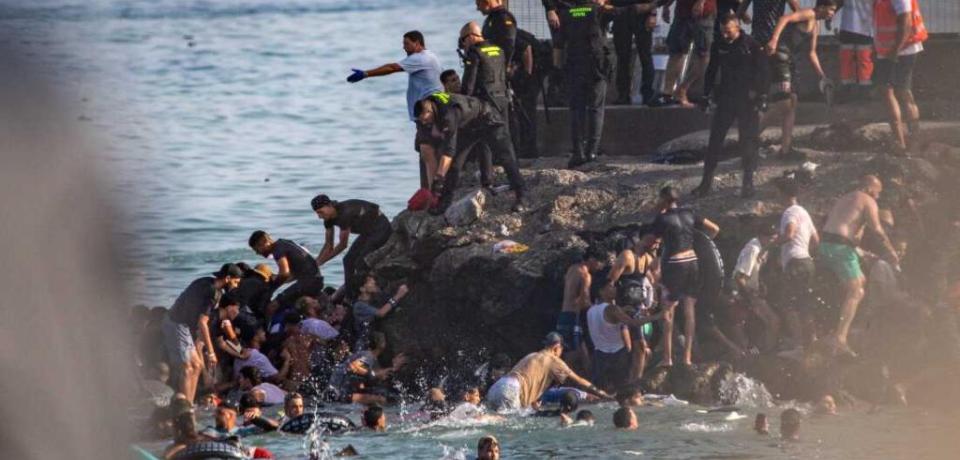
As the hours pass, the Ceuta tragedy takes on a greater dimension. There are already reports of more than 90 deaths, and this number will only rise in the coming hours. That is the first point we want to emphasise: the cruelty of the border regime in North Africa directly leads to the loss of lives among the poorest and most vulnerable sectors of the global population. Faced with the indifference and dehumanisation this system offers us, we want to make clear this is, above all, an unjust tragedy that has taken human lives.
These deaths add to the hundreds of lives lost each year in the mass grave that the Mediterranean Sea has become. Lives lost due to a border regime promoted by the European Union and the Spanish State, with the State of Morocco’s complicity.
The Alawi regime and oligarchy that governs Morocco obviously bears a great responsibility for this tragedy. They exploit their people’s tragic situation for their own benefit, encouraging certain movements of people to serve their interests. Their ties to the United States and Israel are well known, as is their long-running conflict with Algeria. The Moroccan regime is a repulsive dictatorship that does not hesitate to colonise Western Sahara and repress peoples like the Rif, as well as protests by its own population.
However, the fact that the Alawi regime has exploited its people’s desperation for its own interests should not obscure the reality of the situation. Many people, driven to desperation by poverty and a lack of opportunities, try to migrate to imperialist countries in search of a better life. Impoverished by neocolonialism and local oligarchies, these people are not an invading army: they are part of the global proletariat and, from a class perspective, deserve our solidarity and humanity. Those on the left who today question this and take a one-sided view, reducing the situation to a simple conspiracy, only seek to whitewash the Spanish State’s and EU’s responsibility in the whole drama. Back in June 2022, Spain’s progressive coalition government launched an offensive that, together with Moroccan forces, left 22 people dead and hundreds missing in the Melilla border tragedy.
Today, militaristic rhetoric tends to dominate public debate. Rhetoric based on concepts such as “invasion” or “violation of national sovereignty” reflects the extent to which the ideas that the right and far right seek to impose on society as a whole have even permeated sectors that consider themselves progressive.
The EU and Spanish State (governed by the “most progressive government in history”) have outsourced much of its border protection to the Moroccan regime while legitimising its colonisation of Western Sahara, thereby abandoning the Sahrawi people’s historic struggle. But that is not all. The Spanish State and EU are members of NATO, an imperialist and militaristic bloc that, despite its tensions with the US, is part of the same network of domination over the peoples and countries of the Global South. The enrichment of European and Spanish capitalists is based on a combination of exploiting their own working class as well as those of post-colonial countries, and the plundering of their lands and economies. Therefore, framing this as a dispute along nationalist lines fails to recognise the complex power relations imposed by imperialism, and incites a conflict that could lead to war.
Faced with confrontation between working classes along national lines, we must be clear and point out that the economic and political elites of both countries benefit from this situation. Borders do not prevent migration: they only make it more cruel and discipline migrants. They create better conditions for capitalists to overexploit migrants, thus lowering the standard of living for the entire working class. Spanish capitalists shamelessly take advantage of this situation, profiting from low wages to maintain profits.
This relationship also has a very concrete economic expression. Large companies such as Acciona, Indra, and Repsol, along with financial institutions such as Santander, profit from the exploitation of resources in occupied Western Sahara and from sustaining the Moroccan economic model. Meanwhile, Morocco remains a key player for France, Spain, and the US as a supplier of cheap labour for agriculture, the care industry, and the service sector. Behind the rhetoric of good neighborliness lies an alliance built on economic, geopolitical, and business interests, in which tensions and divergent interests sometimes surface, but which ultimately responds to the same systemic model and same class interests.
Our position is clear. We defend legal and safe pathways for migration and an end to border militarisation, prioritising migrants’ human rights. This would prevent humanitarian catastrophes and the use of migration as a tool for blackmail. We consistently combat racism and advocate for unified organisation of the working classes, regardless of their country of origin. We denounce and fight against the economic interests and political systems of the Spanish and Moroccan states, and believe only solidarity among peoples can resolve the underlying problems.
We are also not naive. Under the capitalist and imperialist system, we can win some improvements, and fighting for them is fundamental to avoiding falling into the abyss. However, only by transforming this system along socialist and internationalist lines, and establishing federative, solidarity-based, and associative relationships among peoples that are not mediated by the economic and geopolitical interests of a few, can we establish truly safe and open forms of freedom of movement. While we fight for this, we must uncompromisingly defend the human rights of all migrants and identify and combat the ruling classes of all countries, who are responsible for this tragic situation.
Therefore, to improve the balance of power here and now, we believe it is essential to fight for:
• The repeal of the Immigration Law.
• An end to the European Pact on Migration and Asylum and the dismantling of Frontex.
• An immediate strengthening of the migrant reception system.
• An end to “hot returns” [where migrants are returned without any processing or opportunity to claim asylum].
In the face of border cruelty, racism, and conflict between peoples: internationalist and class solidarity!
2 August 2026
Translation by Federico Fuentes for LINKS International Journal of Socialist Renewal.