Statement by the al-Mounadila Current
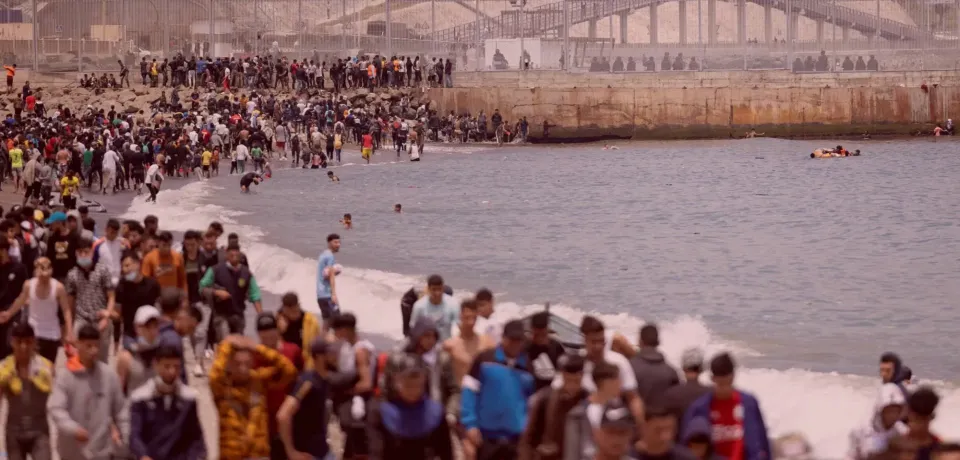
The provisional death toll announced for the tragedy off the coast of Ceuta stands at over sixty, all victims of forced migration. We are not facing a conventional war here, where shells rain down and gunfire rings out, but a daily social war – seemingly silent, yet bloody in its consequences – which claims the lives of the most destitute and drives young people to risk their lives on the very brink of death.
The actual number of victims will undoubtedly be higher than that reported. As for the injured, the missing, and the survivors who will bear the scars of this trauma for the rest of their lives, as well as the mothers whose hearts have been broken by the loss of their children, no statistics can do justice to their tragedy, and no official statement dares to acknowledge its full extent.
The fundamental question is not: ‘How did these people die?’, but: ‘Why were they driven, in the first place, towards this fate?’
Who is responsible for this social massacre that has been going on for years? Who is responsible for the fact that the sea washes up corpses one after another, and that fishermen’s nets bring up the bodies of the drowned instead of the bounty of the sea? Who is responsible for a homeland where thousands of young people have come to regard emigration, whatever the risks, as a fate preferable to that of staying?
This tragedy is not the result of individual choices or mere short-term mismanagement. It is rather the product of an economic and political structure based on dependence on global capital and international financial institutions, which, through debt, imposes austerity policies, privatisation and market liberalisation, deepening dependence, unemployment and precariousness, whilst dismantling public services. This situation makes emigration, for large sections of the youth, one of the few possible ways out. Debt is not merely a matter of figures in a budget, but a mechanism designed to subordinate public policies to external diktats, in which debt servicing and investors’ profits take precedence over the right to work, education, healthcare, housing and a life of dignity.
A few days ago, official reports and those from international financial institutions were published, celebrating ‘economic achievements’ and presenting indicators of growth and stability as if they were proof of the success of current policies. But what sort of success is this, when millions of citizens are facing unemployment, precarious living conditions and despair? And what sort of development is this, if it drives people to flee their homeland or die at its borders?
This tragedy is, moreover, inextricably linked to the nature of the current political regime, which has chosen to position itself as a key partner in Europe’s imperialist strategy of sealing borders and blocking migration, in exchange for political and financial support. Instead of guaranteeing citizens the right to a life of dignity, a growing proportion of the security and military apparatus is being mobilised to act as ‘border police’, as part of foreign policies aimed at protecting Europe from migrants, rather than protecting peoples’ right to development, freedom and free movement.
This security role abroad goes hand in hand with a repressive policy at home. The regime cracks down on youth protests and social movements, restricts freedom of association and expression, and persecutes journalists, bloggers and activists. It responds to protests by Generation Z and other movements with arrests and trials rather than addressing their demands. It denies young people any prospect of participation or change, and thus drives many of them to see emigration – with all its risks – as the only way out. Forced emigration and political repression are two sides of the same coin: a policy that deprives people of any right to a future.
Reality highlights the stark contrast between the narrative of official figures and people’s actual lives. Profits and wealth accumulate in the hands of a minority that monopolises privileges and resources, and the profits of large corporations and speculators continue to rise. Meanwhile the circle of poverty and marginalisation is widening, living and working conditions are deteriorating, and the majority of the population is forced to bear the cost of policies that do not serve their interests.
That is why the answer to these tragedies does not lie in mere lamentations, nor in increased repression, nor in the hermetic sealing of borders, but in a radical change to the policies that give rise to poverty, marginalisation and forced exile. We need to establish a social and popular balance of power capable of imposing a comprehensive alternative. This alternative must break with dependency, cancel illegitimate debts and establish popular sovereignty over wealth and economic decisions. It must also guarantee the right to decent work and a decent income, to education, healthcare, housing and democratic freedoms. We also need to channel national wealth towards meeting society’s needs rather than towards the enrichment of a privileged minority and serving the interests of local and foreign capital.
Those who sow poverty, exploitation, dependence and despotism can only reap resistance and struggle. Indeed, any widening of social inequalities breeds greater discontent, and any intensification of exploitation, as well as any restriction of freedoms, fuels the desire for change. History teaches us that when people become aware of the link between economic exploitation, political despotism and dependency, and when they organise themselves, they become capable of securing their rights and bringing about a fairer and more dignified future.
The global social and democratic alternative is not a dream to be put off until later, but a necessity imposed by the blood of the victims, the suffering of mothers and the squandering of the future of entire generations. With every day that this alternative is delayed, the cost of the human and social tragedy grows heavier, whilst only workers and the poor pay the price.
Our people will only begin to chart their course towards genuine social justice and freedom when their social resistance leads to the rebuilding of struggle organisations endowed with great perseverance, with a view to addressing the following key demands:
– An end to the criminalisation of activist action and the release of all detainees from social movements, foremost among them the activists of the Hirak du Rif and young people of Generation Z, and the suspension of all legal proceedings against journalists, bloggers, artists and singers.
– The elimination of all forms of precarious work in the private sector, through the regularisation of all workers, an end to the abusive use of fixed-term contracts, and the abolition of subcontracting and labour agencies.
– An increase in the minimum wage to 5,000 dirhams in private-sector companies, whether in the agricultural, industrial, commercial or service sectors.
– The abandonment of all policies and measures aimed at transforming social services, particularly health and education, into market-based services subject to private-sector logic, through the following means:
• Reaffirming the principle of free healthcare and hospitalisation by repealing the decree imposing the payment of healthcare fees,
• Abolishing all tax breaks, as well as all concessions and authorisations granted to private companies enabling them to monopolise the health and education sectors.
– Putting an end to the land and water grab.
- Put an end to the monopoly of large capitalist companies over our mineral wealth. These resources must be taken back from the major capitalist groups and their management must be ensured by public enterprises under popular control.
– Abandon price liberalisation, particularly for foodstuffs, essential goods and pharmaceuticals, by repealing the law that liberalises them. Introduce mechanisms to protect the domestic market and small-scale production against cyclical price fluctuations. This entails introducing other mechanisms to protect workers’ purchasing power, such as an index-linked system for prices and wages, as well as maintaining the fund to support essential goods.
– A thorough overhaul of the tax system to establish a fair regime, one that no longer places the bulk of the tax burden on workers and the working classes, as is currently the case, whilst the wealthiest — holders of financial capital, large corporations and speculators — benefit from tax exemptions. This overhaul must be based on the introduction of a genuinely progressive tax system.
31 July 2026