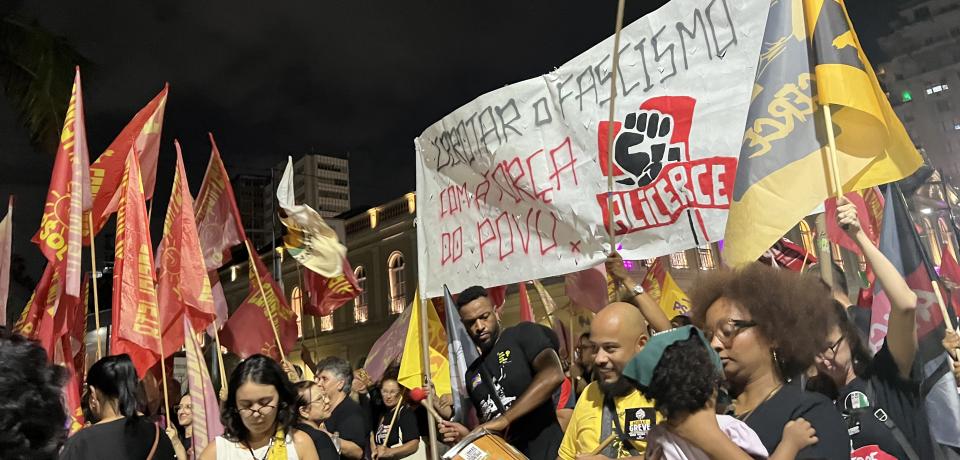
The first anti-fascist conference for the sovereignty of peoples was a unique experience, nowhere else on the planet has anything like this been achieved. It represented a broad anti-fascist and anti-imperialist front, going far beyond revolutionary organizations. Nevertheless, it had limitations, stemming from the difficulties faced by internationalist resistance movements. - Manuel Rodriguez Banchs, Penelope Duggan, Israel Dutra, Antoine Larrache, João Machado, Reymund de Silva and Eric Toussaint, members of the Fourth International Bureau and International Committee.
Nearly 7,000 people took part in the opening demonstration, with a significant presence of Fourth International organizations. We witnessed the militant fervour of the World Social Forums of the heyday and of the 2003 anti-war movement, in which thousands of people from very different backgrounds come together and discuss everything. These are the kind of militant moments in which shared understandings and common objectives are forged, and in which the consciousness of the militant vanguard is shaped.
From outside Brazil, the Argentine delegation was the largest, with 200 people, many of whom had travelled by coach, including our comrades from Marabunta. Comrades came from Africa (South Africa, Mali, Congo, Kenya, Ivory Coast, Morocco) and Asia (India, Pakistan, the Philippines…), particularly through the CADTM (the Committee for the Abolition of Illegitimate Debt, which played a central role in organizing along with the Local Organizing Committee of the conference). Delegations from imperialist countries (the United States, Canada, Australia and European countries such as Belgium, Denmark, France, Italy) were, of course, present. There were important delegations of Ukrainian and Russian activists.
The conference proceedings
Following a “parliamentarians’ panel” and an “elected representatives’ panel” which highlighted an essential link with actions taken within institutions, several thousand people took part in numerous debates on a variety of topics: analysis of the rise of the far right, the struggle against Milei, the resistance to Trump in the US centring on Minneapolis, the specific nature of struggles in the world of work, the situation in Brazil, the Palestinian resistance, the climate crisis, feminism, education, and many different forms of international solidarity.
In addition to taking part in the eleven plenary sessions of the “official” programme, organizations and activists of the Fourth International proposed a number of self-organized activities, among the 150 scheduled. Our comrades played a significant role in these, particularly through a presentation of our Manifesto for an Ecosocialist Revolution – Break with Capitalist Growth, which was attended by over 600 people. This meeting was led notably by Michael Löwy, one of the main drafters of the Manifesto, and Penelope Duggan, who represented the Fourth International.
We also organized or contributed significantly to debates on the anti-racist and anti-capitalist struggle, solidarity with Ukraine, with Russian prisoners, the situation in France and solidarity with migrants. The first of these in particular brought together several hundred people.
Important activities were organized by CADTM on immigration, Gen Z mobilizations, the hoarding of wealth, the grabbing of natural resources of Ukraine, DRC and Venezuela, the situation in Africa, and others.
The Fourth International distributed a statement, “Against Neo-Fascist Authoritarianism and All Forms of Imperialism”, to the conference participants in four languages.
The final declaration
The conference’s final declaration summarizes the broad agreements that made its organization possible: a reminder of the major mobilizations against Milei, against the far right in Britain, the No Kings! mobilizations in the United States, and solidarity with Cuba. It also sets out a series of social, environmental, anti-racist, feminist, and LGBTIQ+ demands, and of course demands against imperialism. It states clearly: “We oppose all imperialisms and support the struggle of peoples for their self-determination, by all necessary means.” In particular, the declaration opposes the genocide in Palestine, the attacks on Lebanon and Iran, as well as the invasion of Venezuela and the threats against Cuba. This broad consensus brought together extremely diverse organizations, which contributed to the conference’s success.
Limited mobilization by mass workers’ organizations
The great success of the conference does not blind us to some significant limitations. These were apparent during the preparation of the conference, and we tried, with limited success, to address them.
One was the lack of active participation from traditional mass organizations both in Brazil and elsewhere. Whilst the conference secured the formal participation of both the Workers’ Party, and of the majority of the PSOL nationally, as well as the CUT Brazil, CTB Brazil, and other teachers and trade unions, these contributed little to the building of the mobilization outside the state of Rio Grande do Sul where Porto Alegre is situated. The Andes teachers’ union and the Communist Party of Brazil (PCdoB) had a larger militant presence. In fact, our organizations – in particular the MES, a tendency within the PSOL that is particularly strong in RIo Grande do Sul – made up a large part of the attendance: on the one hand, this is something to be proud of, but on the other, it reflects the fact that the struggle for unity, for building a mass movement alongside reformist organizations and the trade unions, still lies ahead of us.
From outside Brazil the conference was also supported by la France Insoumise, and a series of trade-union organizations notably from the Spanish state and Latin America.1 In the run-up to the conference, repeated attempts were made to convince many other organizations of the conference’s importance for their movements, but this struggle for the broadest possible unity within the movement must continue to be waged with the utmost determination.
Opposing all imperialisms
Another was the almost exclusive focus in practice on imperialism as US imperialism alone, despite the final statement’s opposition to “all imperialisms”. Thus, under the influence of the “campist” sectors of the conference, there was no condemnation of Putin’s Russia’s invasion of Ukraine, nor a clear stance on the nature of the dictatorial regime in Russia. This is a serious problem and potential obstacle to joint activity with anti-fascists from Russia and Ukraine. Russia is undoubtedly one of the regimes that most closely resembles fascism, whilst the Ukrainian people – and the Russian people too! – are suffering under this regime through deprivation and hundreds of thousands of deaths.
The presence of Russian and Ukrainian comrades, and the workshops organized with the support of the Fourth Internationalists giving a voice to Russian oppositionists, and a Ukrainian delegation of two leading trade unionists and a representative of Sotsialnyi Rukh, was an important counterweight. This was welcomed by the delegations concerned and in the words of the RESU/ENSU representative “The presence of Ukrainian comrades, as well as that of Russian socialist opposition figures, was highlighted […] particularly during the conference’s closing session led by Roberto Robaina. They were also able to speak with activists from Brazil and other countries. And they gave interviews and filmed videos which are currently being circulated amongst left-wing organizations”. They hope to build on this to broaden solidarity for their struggles, notably in Latin America.
In several plenaries, Fourth International comrades (Penelope Duggan from the FI leadership, Rafael Bernabe from Puerto Rico, Sushovan Dhar from India,...) and others (Patrica Pol from ATTAC France and LFI) also spoke against these positions, defending Russian prisoners and oppositionists in exile, the right to self-determination of Ukraine and the battle of the Ukrainian people against the Russian invasion and the neoliberal and anti-democratic policies of their own government, and in support of the Iranian women’s and democratic movement. Our stance is for the right to self-determination of all the peoples of the world by their own action and not by aligning with any government, but it is clear that this fundamental battle was not fully resolved at the conference. In the self-organized workshops several FI comrades speaking (André Frappier from Canada, Eric Toussaint from Belgium, Bruno Magalhães from Brazil) also condemned the Russian invasion of Ukraine and supported the right of Ukraine self-determination.
Mixed message on Iran
Although the final statement “upholds the self-determination of the Iranian people”, an unofficial representative of the Islamic Republic of Iran was present and justified – in very moderated tones – the regime’s policies. Whilst we defend the Islamic Republic’s right to defend itself against imperialist aggression, and wish for the defeat of this attack, we fully support the social movements in Iran, particularly the feminist movements, which have nothing to do with the representatives of the Shah sponsored by the United States and Israel.
Strengthening democracy in the movement
It was undoubtedly inevitable in a conference of thousands of activists that there was the lack of real forums of debate among the participants, both on the political topics discussed in the central plenary sessions (the self-organized workshops were different), and in particular on the final statement and what it proposed. Whilst we all agree with building the initiatives enumerated and the Fourth International will be present at them all, the organizing nucleus must be broadened and develop mechanisms of democratic accountability. This is important both in terms of political representativity but also - as had been pointed out in the international organizing committee - gender parity. Moreover, while we can note a presence of women speakers in all the panels, the problematics of feminism were largely absent from the official panels, although of course present in a number of self-organized workshops.
Let us continue the struggle
In conclusion, the conference is an extremely important step forward in the battle against fascism and imperialism: let us not forget that it has been years since any social forum brought together so many people.
The practices of building international and internationalist movements have been lost and must be rebuilt.
The decision to seek a united anti-fascist and anti-imperialist front entailed some loss of clarity in the common statements, given that understanding on the left and among popular sectors regarding such basic questions as who are the fascists or neo-fascists, or who are the imperialists, vary greatly. Thus, the decision that guided the organization of the Conference—and which was also the position of the Fourth International—was that it was important to hold the conference, even at the cost of a significant loss of clarity. The only alternative would have been not to hold the Conference, to renounce the possibility of bringing together thousands of activists to discuss points of agreement and disagreement and commit to the ongoing struggle against fascism and imperialism.
Political battles are fought in practice, by participating in the movements that actually exist; we can only exert influence if we participate fully. The organization of this conference, and the series of pre-conferences notably in Brazil that were an important aspect of mobilizing for the conference, relied largely on activists from the Fourth International, particularly our organizations in Brazil—notably the MES, Centelhas and Ecossocialistas—our comrades involved in broad-based organizations and associations, and other internationalist, anti-colonial and anti-imperialist organizations.
There is no doubt that the debates and struggles will continue, and the next events are already set: the G7 counter-summit in France and Switzerland in June 2026, the anti-NATO gathering in Turkey in July 2026, and the World Social Forum in Benin in August 2026. Also proposed are continental conferences, notably in North and South America, as well as the Ecosocialist Encounters in May in Belgium.
It is through all these events that the alliances necessary to counter fascism and imperialism are being forged. It is up to us to involve the trade unions, human rights organizations, feminist and LGBTQI+ movements, anti-racist organizations, those campaigning for Palestine, and those standing in solidarity with the Ukrainian and the Iranian people. It is in this way – and by defending our eco-socialist revolutionary perspectives – that we will build the movement needed to change the world.
4 April 2026
- 1
Including the two main Basque trade unions ELA and LAB, the Intersindicals of Valencia, Galicia and Catalunya, CTA A Argentina, CTA TT Argentina, PIT CNT Uruguay, SME Mexico, CUT Chile, CUT Colombia.