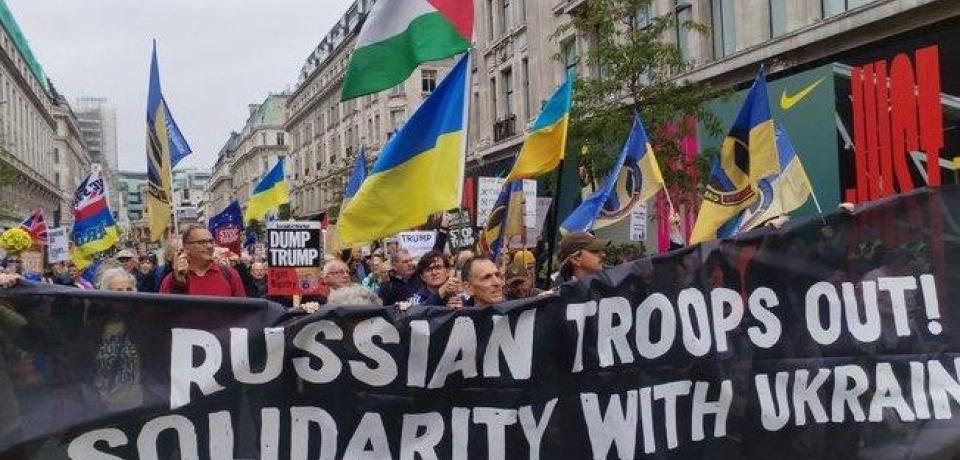
These notes were the basis of a report by Christian Varquat to the October 2025 meeting of the Fourth International Bureau.
1.- Continuation of Putin’s Russian offensives in Ukraine
The large-scale Russian invasion of Ukraine and the war have now lasted more than three and a half years.
- On the front lines, Russian troops continue their attacks along the front and are advancing very slowly in Donbass, Kharkhiv, Zaporizhia and Dnipro, at the cost of enormous losses... and the Ukrainians are holding out despite exhaustion and the anti-social policies of the Ukrainian government. The use of drones of all types is playing a major role.
- Putin is stepping up his policy of bombing cities and infrastructure, particularly energy infrastructure, throughout Ukraine on a permanent basis. With fewer missiles, but many more drones.
- We are also seeing the forced Russification of the occupied regions: fierce repression, property grabs by Russians brought in from afar; Russian passports and education imposed, forced enlistment in the Russian army, and a policy of abducting tens of thousands of children to Russify them.
2. The back-and-forth with Trump
- The Anchorage summit on 15 August 2025: Putin gained recognition/validation from Trump, with arguments divided on certain points (blaming Biden and the Europeans for the war, Crimea being Russian, etc.).
- An agreement to end the war is said to be close (but without starting with a ceasefire), with all the pressure on Ukraine... but no concrete progress.
- Trump showed his impatience in the following weeks: refusal then agreement to supply weapons to Ukraine, pressure on Zelensky to cede territory, then on Putin, the Budapest summit at the end of October trumpeted then cancelled, announcement of sanctions against Russia then relativised... Trump is seeking an agreement like the one on Gaza.
3. Russia’s September provocations in Europe...and the reactions
- We saw multiple drones and military flyovers by Putin towards European countries:
July Lithuania, 10/09 drones Poland, 13/09 drones Romania, 19/09 Mig Estonia, 25/09 Mig Latvia; drones flying over airports in Denmark, Sweden, Norway, Lithuania, France, Germany and Belgium.
- The Russian ‘ghost fleet’ continues to transport export goods, while also carrying out minor provocations/tests of European reactions.
- Russian cyberattacks continue, as do attempts at political destabilisation and pressure on elections in Moldova - and elsewhere?
--> The European Union is laboriously stepping up its support for Ukraine... and vigorously pursuing its industrial rearmament policy!
4. Realities and contradictions of European rearmament dynamics
- There is a real fear of Putin’s fascist Russia... and Trump’s USA in the public opinion of most European countries, except on the far right.
.- This fear is being exploited by governments to legitimise rearmament, with a double standard in their democratic discourse towards Russia, Israel and the dictatorships of the Global South.
- We can consider the lack of consistency in the aid provided to Ukraine by the major European powers since February 2022, which differs from that of the states of Eastern and Northern Europe: attempts at compromise with Putin (Solz, Macron), arms shipments that are much more assertive than they are realised, such as sanctions against Russian officials.
- Neoliberal policies are demanded even when they actually weaken the Ukrainians, with debt being used as a tool to increase Ukraine’s dependence.
- The deadly trend of rearmament by the European Union and each European state is unfolding: this is the (half-hearted?) affirmation of a ‘Europe of defence’ in the context of global competition and economic crisis, under pressure from the US (for Trump/against him, depending on the moment) and backed by NATO and Fortress Europe!
After a significant decline after 1991, European defence budgets have doubled in 20 years (especially in the last 10 years), but with very little coordination in terms of industrial and military applications. These budgets currently represent 2% of European GDP (US 3.1%). +19% in 2024, +7.2% in 2025
This militaristic acceleration can be seen first in Central and Eastern Europe (Poland 4.8% of GDP), then Germany (+20% in 2026), France (+13% in 2026), the United Kingdom, etc.
The goal is to double these budgets again by 2035 to reach 3.5% of European GDP.
5. How can we combat rearmament and fight for people’s rights?
- Ukraine is merely a pretext; military support for its self-defence is possible without increasing military budgets at the expense of social and environmental budgets (by recovering frozen assets belonging to the state, large companies and Russian oligarchs).
- The fight against far-right populism is primarily socio-political and democratic.
- We are interested in defence issues. It is undeniable that the Russian regime is increasingly focused on imperialism and war, concentrating its military resources as part of its policy of enslaving its people in order to survive.
But our considerations and conclusions are, of course, different from those of the capitalists and their servants. Our compass is popular emancipation, democracy and the allocation of resources above all to social and environmental justice.
There are lessons to be learned from the Ukrainian resistance, both positive and negative, and there are new ideas to be developed in order to have an independent policy!
- We must continue to support and connect with our Ukrainian comrades in Sotsialnyi Rukh and the forces of civil society in Ukraine who are fighting on two fronts: against Putin’s imperialist invasion and against their neoliberal and corrupt government (we saw the reality of this orientation on a large scale in August).
- We must also support Russian opponents who share this view.
- We must try to strengthen the internationalist, anti-colonialist, anti-capitalist European left and oppose anti-social and anti-environmental rearmament.
For example, in European conferences of social movements such as the one in Brussels last spring, which is to be repeated in Paris in June 2026.
27 October 2025