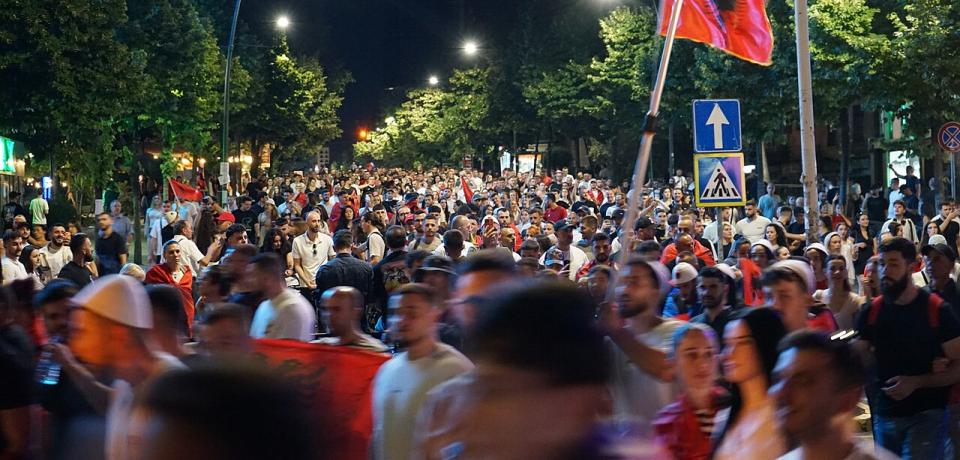
Since November 2024 the Balkans have seen the largest sustained street mobilisations in more than 30 years. In Serbia, the collapse of the Novi Sad railway canopy put students and workers on the streets in numbers not seen in a generation, and they have stayed there for eighteen months. In Bulgaria, protests against the 2026 austerity budget — the largest in decades — brought down the Zhelyazkov government in December 2025. In Albania, opposition to the Kushner-backed resort at Zvernec grew from a village blockade in May 2026 into the "Flamingo Revolution", with 1 in 10 of the national population on the streets on 20 June and daily demonstrations in a dozen cities. In Bosnia-Herzegovina, communities are resisting mining concessions granted over their heads by law.
These are not separate national crises. They are responses to the same thing: governments across the region selling land, minerals, coastline and labour to whichever foreign power will pay, and policing the population that objects.
Serbia may be heading toward elections. But President Aleksandar Vučić intends to move to the office of prime minister rather than leave power. Neither the ruling Serbian Progressive Party (SNS) nor the liberal parliamentary opposition has offered a credible answer to the demands that have sustained the youth-led protest movement since November 2024: accountability for the disaster, an end to the Jadar lithium project, and an end to impunity for the violence used against protesters. If elections are held, the students and the other campaigns that have carried this movement should nominate their own candidates — people who represent these demands directly — rather than leave the ballot to politicians who have failed to answer them.
Vučić has spent years hedging between Moscow, Beijing, Dubai and Brussels, selling access to Serbian resources to each in turn in exchange for their toleration of his rule. Albania and Montenegro have taken the opposite course, competing to be EU accession "frontrunners" through unconditional compliance — and have seen the same pattern of foreign-backed dispossession of public land regardless.
The Kushner-backed resort project at Zvernec and Sazan Island in Albania is the clearest case. Our solidarity is with the communities defending protected wetland and public land from dispossession, and the left-oriented Lëvizja Bashkë (Together Movement), which has organised against Prime Minister Edi Rama's accommodation with Kushner's capital on that ground.
Neither strategy, Vučić's hedging nor Rama's compliance, is a road out of peripheral dependency
Three decades after the Dayton agreement, Bosnia-Herzegovina remains a western protectorate, under a foreign (so far, always EU) High Representative empowered to override its own institutions, controlling the state's sovereignty from foreign capitals regardless of the population's will. Governments in both of Bosnia-Herzegovina are obsessed with the same resource politics seen in Serbia: a 2024 law in Bosnia-Hercegovina’s Serbian Republic stripped local communities of the right to consent to mining on their own land. Serbian Republic leader Milorad Dodik, defying the Bosnian state court, has offered Donald Trump access to raw materials in exchange for US backing of a secession of Bosnia-Herzegovina’s Serb majority entity —most likely followed by union with Serbia itself. In 2026 Bosnia’s Croat-Muslim Bosnian Federation government — traditionally pro-EU and pro-NATO — awarded a major gas pipeline project without competitive tender to a US company with no prior infrastructure experience but reported links to Trump, prompting the EU's own ambassador to warn that Bosnia-Herzegovina's accession prospects and access to EU aid were now at risk.
Across the region, leaders are now betting that Trump's Washington, unlike Brussels, will trade some meaningful recognition or support for a cut of the resources underneath their feet.
The EU controls Kosovo by a different mechanism: Five EU member states — Cyprus, Greece, Romania, Slovakia and Spain — still refuse to recognise its independence, for reasons rooted entirely in their own domestic nationalities politics rather than anything Kosovo has done. Because EU accession requires unanimous consent, this blocks Kosovo's membership indefinitely.
Bulgaria's current crisis shows that even full membership does not resolve the problems of the EU’s peripheral states. Already inside the EU since 2007 and the eurozone since January 2026, its government collapsed in December 2025 under the weight of protests against an austerity budget.
The Fourth International supports the demand for every European citizen, whether their country belongs to the EU or not, to have free access to European goods, to be able to travel and have access to the labour markets — access that offers real material benefits to working people, including the right to work and move freely. The Fourth International stands against fortress Europe and its liberal policies and for freedom of movement.
But this must not be bought at the price of surrendering these countries’ ability to protect domestic industry, agriculture, land and labour standards. Inside or outside the EU, this requires a rupture with current policies. A trade relationship that runs one way, and a ‘European citizenship’ that comes with duties but no vote, is not integration; it is only another form of the periphery these countries already occupy.
The Fourth International salutes the courage of the movements resisting this multifaceted exploitation on the ground and calls for the cross-border solidarity between them that a struggle against transnational capital requires.
- Serbia’s elections are not a substitute for accountability — nominate candidates who represent the movements, not the parties that have failed them!
- No to the Jadar lithium project and all foreign-backed dispossession of Balkan land and resources!
- No land, coastline or public resources for Kushner or any oligarch — Balkan or foreign, East or West!
- End the High Representative's protectorate over Bosnia — for genuine popular sovereignty.
- No to EU accession with duties but no vote!
- Yes to EU market and labour-market access on terms that protect Balkan countries’ domestic industry, agriculture and workers — no to access that demands their sacrifice!
- Neither hedging between great powers nor unconditional integration — sovereignty for the peoples of the Balkans!
Statement by the Executive Bureau of the Fourth International
19/08/2026