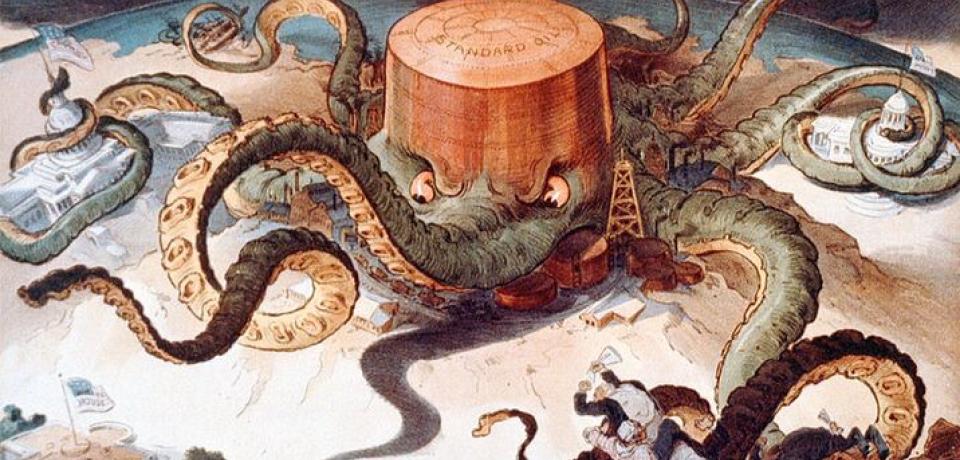
This is the first part of a report on Imperialism made at the International Committee meeting of the Fourth international in February 2026.
In the era of Trump, competition with a rising China, and Russia’s war of invasion against Ukraine, it is useful to revisit the concept of imperialism—which even some progressive figures insist on dismissing, particularly in...imperialist countries. The idea here is to recall its origins and some of the important controversies and debates surrounding this economic, political, and military phenomenon, so that we are on the same conceptual page. Understanding what we are talking about helps us address current discussions at a time of major upheavals in the international system: why the United States is taking a warmongering and neocolonial turn; how radical the changes in hegemonic imperialism are, with the far right in power in the White House; and what the role and character of China and Russia are at this moment. (See, regarding China and Russia, Peter Drucker’s article: Inter-imperialist clashes – and their limits.)
The international, global nature of capitalist expansion was explicitly and presciently pointed out in the Communist Manifesto of 1848. In Capital, analyzing the English capitalist model to understand the functioning and general rules of the system as a whole, Marx frequently cites foreign trade as an international element. But it is in the famous Chapter 24 of Volume I that the key insight is found: when discussing primitive accumulation—or, better yet, in English, “previous accumulation”— he recalls that, just as with the enclosures that took place in Europe (with the expropriation of the peasants), the so-called discoveries of the Americas and the lands of Asia—that is, the European invasion of the territories of the current Global South—were essential for the accumulation and industrialization of the European centers and, later, of the United States. Marx was still far from speaking of imperialism. He did not live to see it fully developed, with all its elements.
Imperialism as a new (at that time) mode of operation essential to capitalist development began to take shape in the last quarter of the 19th century, when fundamental changes became fully apparent in the system. In 1880, at the Berlin Conference, the European powers agreed to divide Africa among themselves. In the 1870s, a major European economic crisis occurred, and from the late 1890s onward, with Engels still alive in the Second International, a major debate began regarding the new situation of capitalism, particularly due to its evident international expansion, the rise of German capitalism in Europe, colonialism reinforced by new and more violent methods of expropriating the wealth of the colonized, and the drums of war between imperialist countries.
The European debate
It is impossible to summarize here the breadth and depth of the analyses, debates, and contributions produced by that generation of European socialists. Contributing to the Marxist concept of imperialism were, in particular, the Englishman John A. Hobson, the Austrian political economist Rudolf Hilferding—both of whom produced essential works for understanding the dominance of finance over the capitalist economy—the German leaders Karl Kautsky and Rosa Luxemburg—on opposite sides of the concrete controversy surrounding Social Democratic policy in the face of war; the “Russians” Bukharin, Lenin, Parvus, and, to a lesser extent, Trotsky, with his idea of “uneven and combined development.”
The outbreak of war in 1914 had significantly intensified the debate already underway. Kautsky, then considered the principal leader of the German Social Democratic Party—the largest party in the Second International—pursued a disastrous nationalist (i.e., anti-internationalist) policy of de facto support for German imperialism, with the Social Democratic parliamentary caucus approving war credits. In that same year, 1914, Kautsky published a text in which he posited the possibility that capitalism could avoid war if all the imperialist powers united for that purpose, much like a cartel among companies. He did not name the concept, but his mistaken understanding came to be known as ultra- or hyper-imperialism.
Lenin opposed Kautsky on both theoretical and political grounds, reaffirming that the trend of the new capitalist configuration led, among other things, to wars between powers. In Imperialism, the Highest Stage of Capitalism (1916), written in the midst of the fighting, is the result of a collective discussion. Lenin brilliantly synthesizes the debate, making his own contributions, but always in dialogue and appropriating—in the best sense—elements from earlier texts, such as Hobson’s Imperialism: A Study (1902), Hilferding’s Finance Capital (1910), and Bukharin’s Imperialism and the World Economy (1915, completed in 1917).
Note that the Leninist idea concerns an era, a new mode of operation of capitalism. He is not speaking of a specific phenomenon of invasions and plunder, although these vectors are constitutive of the phenomenon.
- First, it is the era of the systemic predominance of the association between banking capital and industrial capital—that is, the era of finance capital.
- Second, the growing trend toward the oligopolization of capital, that is, the end of free competition. Such competition no longer exists; it takes place among large groups that dominate sectors and, at times, an entire national economy.
- Third, the ever-widening gap between the development of the imperialist industrialized countries of Europe and the United States, which were embarking on their second Industrial Revolution, and that of regions devoted to primary production or very early industrialization.
- Fourth, the tendency of industrialized nations, driven by the needs of their capital, to extend their political, military, and economic power over other nations, particularly those lagging behind in industrial development and the poorest.
- Fifth, the growing rivalry among imperialist powers and the tendency toward inter-imperialist wars.
Imperialism in Transition
This advanced form of capitalism has taken many different forms throughout history:
- The period of the World Wars, that is, the period between 1914 and 1946, during which a significant portion of humanity’s productive forces was destroyed.
- The “Glorious Thirty Years” following World War II, during which the United States reaffirmed itself as the hegemonic imperialist power, replacing the pioneering British Empire. The powers of the time reached an agreement on the rules governing the international system, with the gold standard for the dollar, the IMF, the UN, and all its agencies. It was also a period of great economic development for the Soviet Union and its bloc, the Chinese Revolution, and the decolonization movement in Asia and Africa.
In Latin America and the Middle East, mass-based bourgeois nationalisms emerged, led by Nasser, Gaddafi, and the Baath Party in Iraq and Syria; in Latin America, by Perón, Vargas in Brazil, and Velasco Alvarado in Peru. It was the era of the Cuban Revolution and the uprisings of ’68, which spread from France across Europe and the United States, against the counterrevolutionary war in Vietnam, with repercussions in the then “Third World.”
- The turbulent transitional period of the 1970s. The crises of the 1970s are direct or indirect expressions of insufficient rates of profit and the tendency toward a falling rate of accumulation. In 1971, there was the unilateral abandonment of the gold standard by the U.S.; in 1973, the oil crisis; and the beginning of capitalist restoration in China with the agreements between China and the United States.
Contributions from the periphery
Throughout the period from the end of World War II to the 1970s, there were many debates about imperialism, because there was a colossal anti-colonialist upsurge in the world, including the Cuban Revolution, decolonization in Africa, the revolution and anti-imperialist war in Vietnam, and the Nicaraguan and Salvadoran revolutions in Central America. From these struggles, many contributions from the Global South emerged. Let us mention two fundamental ones.
As a result of the preceding period, certain countries on the so-called periphery of the system began to develop; they did not quite reach the center, but they ceased to be merely peripheral. Mandel participated in this discussion and called them late-industrializing countries. Wallerstein, from the school of thought that draws on Marx, Weber, and Braudel, calls them “semi-peripheral.” And from the Marxist theory of Latin American dependency—which represents the left wing of the developmentalist structuralists at ECLAC (Economic Commission for Latin America), more specifically Ruy Mauro Marini—comes the concept of sub-imperialism. In the context of changes in the international division of labor after World War II, Marini studies the phenomenon of “middle” dependent countries that combine (a) a degree of labor super-exploitation and inequality that limit the realization of value within national borders; (b) the former forces them to shift a large part of industrial production toward exports, while at the same time they begin to (c) extract profits from (exportin capitals to) more fragile countries in their regions, exerting geopolitical influence over them; (d) without ceasing to transfer wealth and subordinate themselves politically to hegemonic imperialism. These are countries that behave like imperialists in their regions but are subordinate to a stronger imperialism. (A concept that Patrick Bond overuses somewhat, for example, by characterizing Russia as sub-imperialist and attaching too much geopolitical importance to the “sub-imperialists” of the BRICs, a heterogeneous group that, in addition to including Russian regional imperialism, includes China, which is now completely detached from “middle-income” countries).1
The second contribution comes from the school of thought known as the “hegemonic transition,” developed by Giovanni Arrighi. Arrighi draws on Wallerstein’s work and conception—inherited from Braudel—regarding the hegemonic cycles of capitalist evolution (Italian cities in the 15th century, the Netherlands in the 16th and 17th centuries, England from the 18th century onward, and the United States from the 20th century onward) to pioneer the identification of the emergence of a Chinese capitalist cycle. His *Adam Smith in Beijing* is from 2007!
There is a third and significant school of thought from this period that claims to be Marxist but did not originate on the “periphery of the system”; this school emerged in the 1950s around the Russian-Polish-born American Paul A. Baran, the economist Paul Sweezy, and the historian Leo Huberman of *Monthly Review* magazine. The concept of the monopoly capital group (or the monopoly phase of capital from those years onward) attracted, as early as the 1960s, the support of the then-young Egyptian researcher and activist Samir Amim—a Maoist and Third Worldist who exerted intellectual and militant influence over sectors of the left in Africa, Asia, and Latin America. Amim is still celebrated today by “Tricontinental” and the Campist left in general for his anti-colonial, popular-front policy aimed at reviving the Non-Aligned Movement born at the historic Bandung Conference (Indonesia, 1956).
The Neoliberal Period
Returning to the periodization: with the victories of Thatcher in 1979 and Reagan in 1980, the period of full implementation of the neoliberal regime began worldwide. This new mode of operation of the capitalist-imperialist system would be characterized, based on the technological leap of digitalization, by a globalization of finance, that is, the deregulation of national finance in favor of a truly international financial system, the establishment of global production chains, productive restructuring accompanied by cuts to rights, the collapse of the welfare state, attacks on unions, and the relocation of industry to Asia.
It was this regime that was on the brink of collapse in 2008, with the subprime crisis in the United States and the recession that followed. To the rise in global inequality, poverty even among the so-called rich, and disparities between core and non-core countries—coupled with the accelerated advance of the environmental crisis — was added the worsening of the structural economic crisis. 2008 marked the beginning of a major period of systemic recession, which China managed to circumvent. Trillion-dollar bailouts by governments for banks and corporations manage to temporarily stall the crisis, but not the recovery of neoliberal patterns of profit and accumulation. The pandemic makes recovery more difficult.
The Rise of Neo-Fascism
In the period between 2007–2008 and 2016, the first signs of the strengthening and advance of far-right groups and movements in the West and the East can be observed: there has been a rise in this phenomenon since 2008, because there is a connection between the crisis of neoliberalism and the far right—neo- or post-fascist—around the world. Growing sectors of the imperialist and peripheral bourgeoisies are embracing a new political strategy that abandons bourgeois democracy as a political model and points toward authoritarianism. The fact that they attract sectors of the masses also has to do with the failure of leftist experiments that sought to co-administer the neoliberal democratic game, such as European social democracy and Latin American progressivism. In any case, the neo-fascist or post-fascist project is a quest to escape the crisis through violence, repression, exclusion, dispossession, and the discarding of human beings.
Is the 2024–2025 period a new watershed moment in the imperialist era?
The answer seems positive to me. The Yankee far right is coming to power for the second time in the hegemonic power, much stronger than in 2016: it has a larger electoral lead over its opponents, currently controls Congress, and has a conservative majority on the Supreme Court. This is a very significant shift in the balance of power and global geopolitics. The bloc currently in power in the U.S. (the coalition of Big Tech, crypto finance, obsolete industries—such as the oil industry—agribusiness, and traditionalist Christian nationalists) also seeks to destroy the democratic system of its own country, turning the United States into a fascist state.
(Even in April 2026, with opposition to his administration surging in the streets and among all kinds of organizations in U.S. civil society, and with record-high disapproval ratings, and with the war unleashed against Iran, more than 30% of the population still supports Trump. Faced with the likelihood of losing control of at least the House of Representatives in November, Trumpism is betting on manipulating the electoral process, state by state. Will it succeed?)
On the global stage, it is no small matter that the Trump administration has been the main supporter of the Palestinian genocide in Gaza. Growing sectors within the U.S., including former supporters of the president in the MAGA movement, point to Trump’s “mistake” in supporting Netanyahu’s expansionist rampage in Iran and Lebanon, at the cost of compromising the “smooth functioning” (profits) of the global economy.
The U.S. had already provided further examples of the true nature of its “National Security Strategy” on January 3, with the abduction of the Venezuelan presidential couple—which is, in reality, the “seizure” of the Venezuelan government and its transformation into a colony. They continue to use tariff blackmail against the EU to supposedly “buy” Greenland and increase military spending, threats against Canada, and the unilateral establishment of a so-called “Peace Council,” chaired for life by Trump, for the also supposedly reconstruction of Gaza.
The picture is one of a significant break with the imperial approach of the past 80 years. The goal is to regain postwar hegemony by force; it maintains China as a strategic adversary in the technological, economic, and military spheres; it omits Russia, in a maneuver; in fact, it breaks the alliance with Europe of the past 80 years and openly incorporates Canada and Latin America into its “territory.”
The U.S. offensive is the result of the decline of its hegemony over the past three decades of the century. It expresses the desperation of U.S. capital to find a way out that will halt this decline. Faced with China’s rise, Russia’s projection of power and uncontrollable autonomy, and the equally unprecedented situation for the U.S. in Latin America and Africa—where China has made a strong economic entry—these sectors supported Trump for an aggressive neocolonialist turn.
There has been a qualitative shift in the belligerence, violence, and openly colonialist nature of imperialism. This is the undisguised colonialism of a hegemonic power that desperately needs to find ways to recover the rates of accumulation (Husson) and profit (Roberts) prior to 2008. As Metveev puts it, “Trump’s radicalism is, ultimately, [also] a response—however disjointed and irrational it may be—to global changes driven largely by China and, to a lesser extent, by Russia.”
More exploitation through expropriation, invasion, looting, and plunder are on the horizon, unless the people and workers of the U.S. put a stop to it. Paradoxically, the goal is exactly the same as that of Putin and Trump, together, regarding Ukraine’s wealth, and what Trump, Israel, and the oil-rich caliphates intend to do with Palestine. None of the above means, however, that it is possible to attribute to Trump’s U.S. the Kautskyian characterization of “hyper-imperialism,” as certain sectors of the “campism” movement do, unable to recognize China as an emerging capitalist power and Russia as a regional imperialist power.
Trump’s policy, in Lenin’s terms, favors the intensification of inter-imperialist rivalries, particularly with China, but also with Russia. Although the language and actions (as in the Caribbean, Venezuela, and Iran) are political-military in nature, and although we are seeing significant signs of a new arms and nuclear race, it is still too early to characterize the international situation as a global war. The sudden and violent shift in the political-economic form of hegemonic imperialism will provoke major inter-bourgeois contradictions, problems within the United States and between nations, as well as popular reactions they cannot control.
The scenario before us is extremely new and uncertain. It leaves more questions than definitive answers. Are we experiencing a bipolarity (US vs. China), as our comrades in the Brazilian APS assert, or rather a disjointed/uncoordinated world, as Matveev argues? What is the degree of Russia’s autonomy in relation to China? Will the U.S. really succeed in imposing an economic disconnection of China from the global market? Will they go so far as to annex territories in the Western Hemisphere, such as Greenland? Will their bellicose moves critically undermine the dollar’s role as a reserve currency? How will they change their military presence in key regions of the world, such as Africa, the Indo-Pacific, and the Arctic? For now, we can only speculate. The important thing is that it will not be Trump’s decisions alone that determine the outcome, but also the national and global reactions to them.” 2
***
References:
Amin, Samir. Imperialism and Uneven Development. 1976. Available at: https://archive.org/details/imperialismunequ00amin
Arrighi, G. Adam Smith in Beijing. Verso, London 2009
Bukharin, N. Imperialism and the World Economy. 1915–1917. Available at: https://www.marxists.org/archive/bukharin/works/1917/imperial/index.htm
Chesnais, F. La Mondialisation du Capital. Syros, Paris, 1994 (first edition), 1997 (expanded edition)
Hilferding, R. Financial Capital. First edition, 1910. Available at https://www.marxists.org/archive/hilferding/1910/finkap/index.htm
Hobson, J. Imperialism: A Study. First edition, 1902. Available at: https://www.marxists.org/archive/hobson/1902/imperialism/index.htm
Kautsky, K. Imperialism. First edition, 1914. Available at:
https://www.marxists.org/archive/kautsky/1914/09/war.htm
Lenin, V.I. Imperialism, the Highest Stage of Capitalism. First edition, 1916. Available at:
https://www.marxists.org/archive/lenin/works/1916/imp-hsc/index.htm
Luxemburg, R. The Accumulation of Capital. First edition, 1913. Available at: https://www.marxists.org/archive/luxemburg/1915/anti-critique/index.htm
Marini, R.M. A acumulação capitalista mundial e o subimperialismo (World Capitalist Accumulation and Sub-Imperialism). 1977. https://www.marxists.org/portugues/marini/1977/06/40.pdf
Marini, R. M. América Latina: dependência e integração (Latin America: Dependence and Integration). 1992, São Paulo, Brasil Urgente. Caracas, Nueva Sociedad.
Marx, K. Capital, Volume I, Chapter 24. Available at:
https://www.marxists.org/archive/marx/works/1867-c1/ch24.htm
Wallerstein, I. The Modern World-System I (1974) Available at: http://pombo.free.fr/wallersteini.pdf
The Modern World-System II (1980): Available at: http://pombo.free.fr/wallersteinii.pdf
- 1
Marini states in his 1992 book *Latin America: Dependence and Integration*: “Subimperialism corresponds to the perverse expression of the differentiation undergone by the world economy as a result of the internationalization of capitalist accumulation, which has set against the simple scheme of the division of labor—crystallized in the center-periphery relationship that concerned ECLAC—a much more complex system of relations. In this system, the spread of manufacturing industry, raising the national average organic composition of capital—that is, the existing relationship between the means of production and the labor force—gives rise to economic (and political) subcenters endowed with relative autonomy, although they remain subordinate to the global dynamics imposed by the major centers. Like Brazil, countries such as Argentina, Israel, Iran, Iraq, and South Africa assume—or have assumed, at some point in their recent evolution—a sub-imperialist character, alongside other sub-centers where this tendency has not fully manifested itself or has only begun to emerge, such as, in Latin America, Mexico and Venezuela (MARINI, 1992).
- 2
Matveev, Ilya. “The World Disjointed – China, Russia and the coming era of inter-imperialist rivalry,” Spectre Journal, Fall 2025, pp. 25–39.