Statement by the secretariat of the Executive Bureau of the Fourth International.
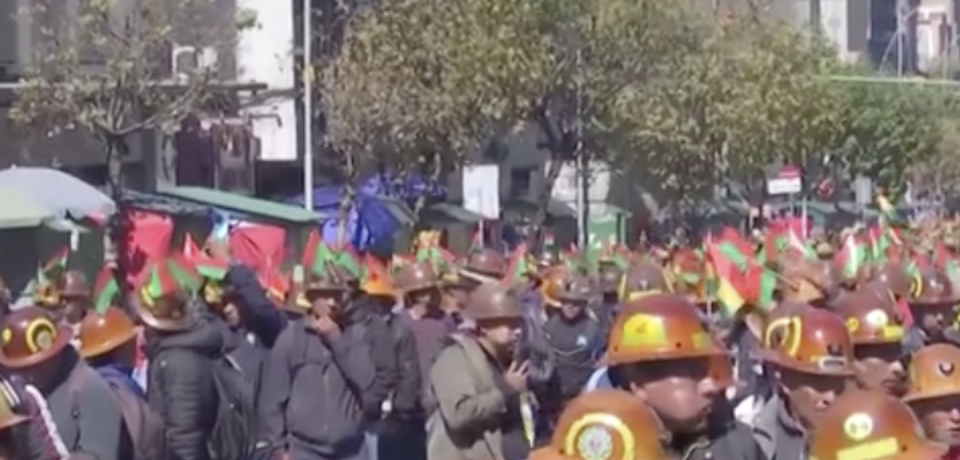
After more than four weeks of social conflict and intense political crisis in the Andean country, and barely six months into his term, the government of right-wing President Rodrigo Paz is already on the defensive and divided. A large uprising of miners (wage earners and cooperative members), peasant communities , and workers in transportation, health care, education, and neighborhood councils—who demanded the president’s resignation while blocking nearly 80 roads across the country—has been accompanied by strikes and protests in La Paz, the seat of government, that have been violently repressed but remain ongoing. The bourgeois press and analysts of all stripes highlight that a large portion of those mobilized are the same people who, after 16 years of supporting the Movement Toward Socialism (MAS—a political instrument, the party-movement of former presidents Morales and Luis Arce), had voted for Paz.
This is the second confrontation by the workers’ and popular movement—overwhelmingly composed of Quechua and Aymara people —against the political alliance elected in November 2025: the first occurred in April, after the Executive announced two provocative decrees. Decree 5503, issued in January, declared a state of emergency to justify ending fuel price subsidies—which resulted in an 86% increase in gasoline prices and a 160% increase in diesel prices—as well as paving the way for ultra-liberal counter-reforms in mining, agribusiness, and infrastructure.
The second decree, issued on April 10, reclassified rural properties (Law 1720) to facilitate the acquisition of large tracts of land (considered medium-sized) by major agro-industrial entrepreneurs and investors, which would lead to the dispossession of traditional indigenous and peasant communities and to deforestation through changes in land use —according to environmentalists and Bolivia’s peasant federations and confederations. In other words, it sought to do something no local neoliberal government had dared to attempt: to reverse the 1953 agrarian reform, an achievement from the 1952 revolution. This decree, which had already been rejected by the Plurinational Assembly (lower house of Congress), sparked outrage among peasant communities across the country (including parts of Santa Cruz), prompting them to organize marches to La Paz. The discontent in rural areas was compounded by anger in urban areas over rising fuel prices.
This month, in the face of La Paz’s refusal to negotiate a 20% wage increase with the Bolivian Workers’ Union (COB) and the brutal repression of the May 16 protests, which left four dead, the anger of workers, peasants, and the people exploded. The seat of government and the municipality of El Alto, the country’s second-largest city with an Aymara heritage and the strongest tradition of struggle over the past 20 years, were mobilized but isolated from the rest of the country. Roadblocks on highways and local roads (more than 80), which had receded due to the repression, have grown again in recent days. A march of thousands of workers led by the COB and the Tupac Katari Peasants’ Union (El Alto), with the support of Bartolinas, the women’s organization of the MAS, and the Peasant Unions and communities from across the Andean region, along with the participation of the social base of former President Evo Morales (from Chapare, Cochabamba), completed the growing rejection of the government and moved on to demand the resignation of Paz. He disappeared from the political scene for over a week, postponed the implementation of the decrees on fuel and land, but, under pressure from the oligarchies and the neo-fascists in power in the most industrialized province of Santa Cruz, he refuses to negotiate with the COB on wage increases.
The combination of peasant blockades with urban struggles echoed the characteristics of the major popular uprisings of the past 74 years—from the workers’ revolution of 1952 to the water and gas wars of 2000 and 2003, respectively, through the popular assemblies of 1970–71, the struggles against the dictatorships of the 1980s, the dual power of the government and the COB during the Siles Suazo years (1982 to 1985), the 1985 miners’ insurrection, and the struggles to defend the Constituent Assembly that established the Plurinational State—which recognized Bolivia as a state of diverse nations and ethnic groups—during the early years of Evo Morales.
Imperialism and the local bourgeoisie know this history, and that is why they are concerned about the breadth and radicalism of the movement. The reaction was swift: U.S. Secretary of State Marco Rubio spoke of a “coup against Paz,” the right-wing in Santa Cruz called for a reactionary Civic March and pressured the OAS to issue a statement in defense of the democratic rule of law (read: the conservative government of Paz). The government severed relations with Petro’s Colombia, which had offered to mediate the conflict. The outcome of the process is unfolding, with violent repression against the leaders as they seek a reactionary solution at the cost of bloodshed.
At this moment, repression continues against roadblocks and marches attempting to reach the Palacio Quemado, along with arrests and persecution of COB leaders and threats of detention against leaders of the COB, Bartolinas, and Evo Morales. Even so, the government is showing weakness: Vice President Lara broke with Paz, after having declared his support for negotiations on wage increases. Paz has already had to backtrack on the decrees issued in January and April. And now peasants from Valle Grande in the plains of Santa Cruz—of Aymara, Quechua, and Guaraní origin —are attempting to join the struggle and march toward the Andean West.
A dialogue commission formed by the Public Defender’s Office, a government minister, the Catholic Church, and leaders of parliamentary caucuses is calling on the government to suspend repression and arrest warrants against leaders, and on the movement to suspend the blockades. However, neither the COB, nor the Bartolinas, nor the peasants have yet decided whether to participate in the negotiations. While the government continues to repress, threaten, and negotiate with the DEA (the U.S. agency for combating drug trafficking), a new wave of repression against coca cultivation is underway.
The Fourth International declares its full support for the struggle of workers, indigenous peoples, peasants, and the entire Bolivian people against the ultra-liberal austerity plans of Rodrigo Paz ; denounces the ongoing repression, Paz’s rapprochement with the far-right in Santa Cruz and Trump’s United States, and vehemently rejects the maneuvers to declare a state of siege.
Long live the struggle of the Bolivian people for better living and working conditions!
No to the ultra-liberal counter-reforms that seek to strip away historically won rights!
No rollback on agrarian reform! Immediate wage increases! Let bills 5530 and 1720 be shelved for good!
Long live the COB, the peasant unions, and the neighborhood councils!
Down with the Paz government’s repression! Immediate release of detained leaders and protesters!
Marco Rubio, Trump, and the OAS out of Bolivia’s internal affairs!
No to martial law!
29 May 2026